7.9M
Skilled manufacturing hands unmet by 2030
Korn Ferry, Future of Work, 2018. Twenty economies. About $607 billion in unrealized manufacturing output on this same line.


We make evolution native with AI.
The hand learns to hold.
The body learns to repeat.
The body learns to grow.
EVOLUTION DOES NOT STOP AT THE HAND THAT HOLDS THE TOOL
For the first time in our species’ history, the intelligence we built learns in months what the body took millions of years to shape.
The body is now the bottleneck, and the tools sold to extend it cannot join one another. Below is the price: hands a factory cannot hire, years a body was not built to work, output lost to injury, and falls an aging frame cannot prevent.
7.9M
Skilled manufacturing hands unmet by 2030
Korn Ferry, Future of Work, 2018. Twenty economies. About $607 billion in unrealized manufacturing output on this same line.
2.1B
People aged 60 or older by 2050
WHO, Ageing and health. People aged 60 years or older.
5.8%
Of global GDP lost to work-related injury and disease
2019 work-related burden, Takala et al., 2024. Disease and injury together.
14M
Adults 65+ who report a fall each year
CDC. About one in four adults aged 65 or older.
THE PRICE OF A BODY THAT CANNOT KEEP UP.
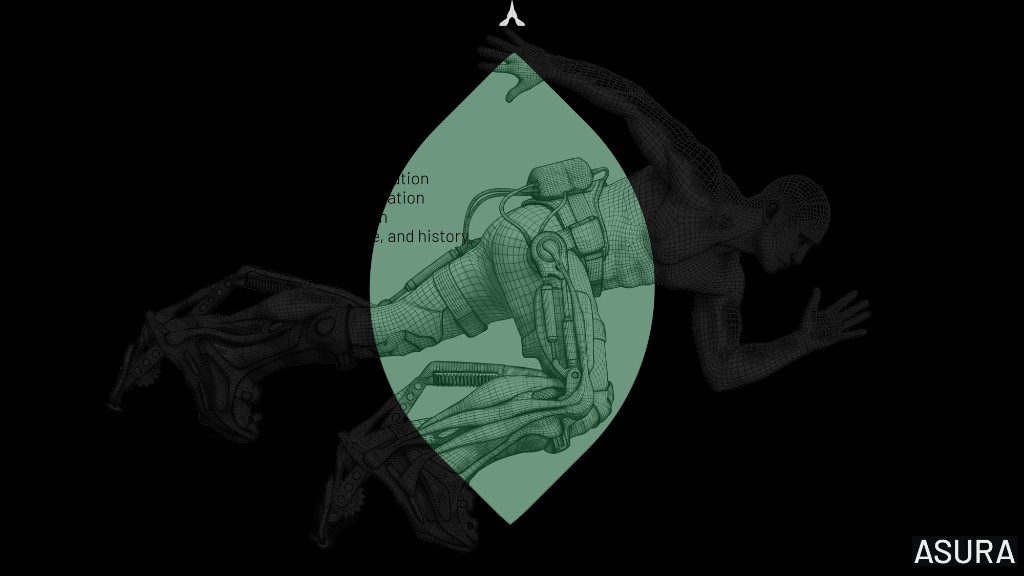
ASURA — THE BODY GROWN PAST THE HUMAN FRAME
Repair returns a body to limits it already had. We carry aisthesis past those limits.
Cyborgnative design takes the body, its tools, and its environment as one system. AI mediates those relations from inside the system.
Technology ceases to be an instrument applied to a human. It is grown as an organ of the life it joins.
The intelligence is already infrastructure. A personal exoskeleton is already a reimbursed product. The years in which those products can still be joined are few.
By 2030, Korn Ferry’s manufacturing line is 7.9 million skilled hands short, across the twenty economies in that 2018 study. Models will be deployed on that clock whether or not a body can carry them.
Investigational brain-computer interfaces are in human studies. Since April 2024, US Medicare has a published fee for personal lower-limb exoskeletons — HCPCS K1007, about $91,000. Sensing, structure, and payment no longer arrive a decade apart.
A device that is paid for on its own hardens into an island. Five years of that, and the shared kernel has to be argued into a market that has already closed.
Transhumanists, workers in exoskeletons, and people with disabilities meet the same absence: a common way to upgrade, and a common way to reach one another.
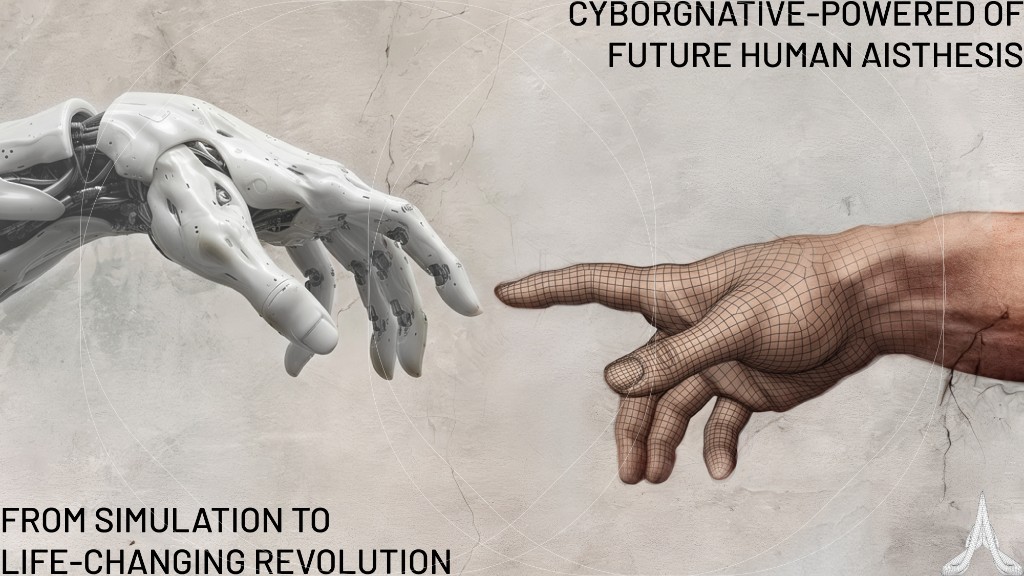
FROM SIMULATION TO A LIVING BODY
Asura is the path. Open Cyborg is the platform that builds it: a body that can be twinned, a kernel every body can share, and an art practice that tests the new sense before it ships.
The carrier. Twins of body, nerve, environment, and task, so structure, sensing, and motion extend past the biological frame — from daily life to the factory floor.
The kernel. Sensors, twins, edge control, and cloud learning, held in common, so an enhancement is no longer an island.
The proof. The new sense is felt in public before it is engineered at scale.
BODY, KERNEL, PROOF — ONE PLATFORM
Prove the kernel in public. Aim it at the price above. Then open it to every aging body.
FROM NOW TO NEXT 5 YEARS
Entertainment and premium — where the kernel is felt
Pain
A factory will not share a kernel that has never been felt.
Gain
Entertainment and premium work prove the new sense in public, and pay for the kernel the later years use.
FROM NOW TO NEXT 10 YEARS
Factory and clinic — where the measured price is paid down
Pain
Unmet hands, injury, and falls are still paid while each device stays an island.
Gain
Factory work and clinical coverage run on the same twins and the same open kernel.
FROM NOW TO NEXT 15 YEARS
The 2.1 billion — a common layer, not a specialty
Pain
People aging past 60 — 2.1 billion of them by 2050 — will not fit inside a clinic or a premium demo.
Gain
A civic layer: a body upgrades, and reaches other bodies, without remaining a medical exception.
Software agents can decide. They still cannot lift, balance, or finish a shift. The scarce layer is a body that can act and be shared. The number below is the published market of devices sold apart.
$740B
Human augmentation published for 2030
Grand View Research · $739.59 billion · 17.3% CAGR, 2024–2030. Exoskeletons, implants, wearables, and immersive tools, sold as separate products.
Agents can plan a motion. They cannot perform it. The first sale is a body that can be twinned and felt in public, so the kernel exists before a factory is asked to trust it.
AGENTS DECIDE. THE BODY STILL HAS TO ACT.
The × is that one sense: the born body and the built intelligence as a single evolutionary process. Asura is the name of that path. Open Cyborg is the platform that builds it.
Each body is a client, with its own twin. One shell for every body fits none of them.
Grow a sense the body keeps. A step that asks the body to give up sensation is the step this path declined.
What is added is perception: a wider way of feeling the world, carried in the body itself.
The first organ is structural: a frame the born body did not have, able to carry the new sense into motion.
A wearable, an implant, an interface: each one is a set of relations across flesh, sense, and computation.
The kernel is common. A body upgrades, changes devices, and reaches other bodies without leaving the path.
What is shown in public, before it ships, is whether a human must remain only human. That answer leads the engineering.
If this path is yours to shape, take twenty minutes.